This post contains affiliate links where I will earn a small commission if you make a purchase through these links and will not cost you anything extra.
With trying to do my part for our environment and future, I have recently turned my attention to Orangutans. Orangutans are one of my favourite animals of the world and unfortuntely, their chances of their survival in the wild are slowly diminishing due to habitat loss and the increase in land clearing to make way for palm tree plantations.

It’s been a long time coming and I really should have started this journey earlier. Better late than never. But as with delving into any topic around sustainability or ethical consumption, it’s not really as simple as googling a recipe. There is alot of information to read about and as an everyday consumer, I’m sometimes left with a hopelessness of not being able to be make any choices because there is no clear winner or the products are overly expensive. There are also many standards and campaigns for companies to be more transparent in their manufacturing and supplying. This can lead to instances where companies don’t have to label their products correctly or appropriately unless it’s mandated by law. It makes the task of being a conscious consumer a little harder.
I thought that I would be easily able to identify palm oil in products by just looking at the label. Upon my research, I was shocked to discover at least another 400 names that palm oil and its derivatives can be listed as and in some countries, simply as ‘vegetable oil’. With Australia’s current labelling law, manufacturers are allowed to label palm oil as vegetable oil.
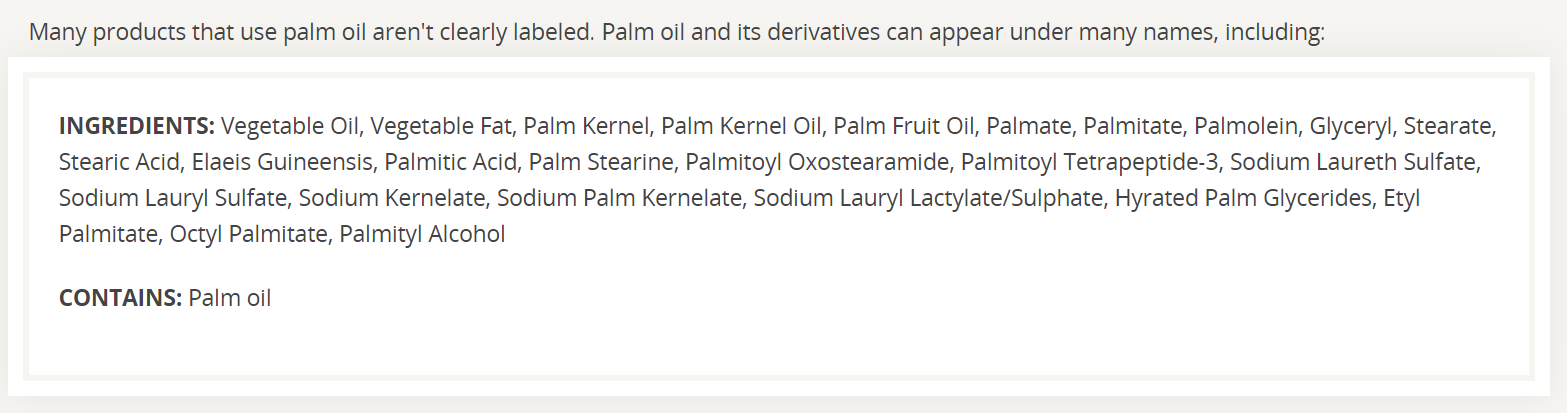
I also found out that palm oil is not solely in foods but also soaps, lipsticks, body wash, butter, snacks and detergents just to name a few. This makes me feel even more guilty that it’s so hard to buy responsibly when there are so many products that contain palm oil.
I decided that the first easy step to take was to look for a substitute for my body wash. It’s something that I use everyday and would be a simple swap. When I go to my local supermarket, I would say that I have about 20 or so different brands to choose from of body soaps/body wash. The largest companies which have majority of the products in this category are also the ones that are the worst rated in terms of their palm oil policy. I’m not surprised.

You may already be thinking ok ok Sophie, get to the point- which soaps should I be buying that contain no or sustainable palm oil?
I’m glad you asked.
If you’re located in Australia and New Zealand, these are the brands that are using sustainable palm oil:
– Ecostore
– Freshwater Farm Australia
– Organic Care
– Only Good (Palm oil free)
– Ethique (ships world wide and Palm oil free)
To shop some of these products (yes they deliver internationally), Nourished Life have compiled body wash that are palm oil free.
Compared to what is available in our supermarkets, this list is very small. Disappointingly small. I’m looking forward to my next informed body wash purchase.
Have you changed any of your products based on learning about something about them? Can you recommend anymore sustainable palm oil or palm oil free brands?
Juste Un Mot:
– True Cost of Fashion
– Reusing Old Clothing
– Taking a Break


Leave a comment