It’s been 6 months since I started writing regularly again. I’ve had a post written almost every week and I actually can’t believe I have thought about enough topics to write about.
I started off initially wanting to write only about travel. But, as you all know what happend this year- I don’t think it’s sustainable for me in the long run. I don’t live a nomadic life on the road. Perhaps it would be easier if I were a committed full-time travel blogger or flight attendant. But I am neither. Nor am I living in a foreign country or city where I would feel the need to be exploring every day or weekend.
Travel or travel?
It’s led me to drill into the definition of travel. Usually used to define a trip to someplace else, the actual definition refers to making a journey or to move. I thought to myself that writing about life is a journey in itself so am hoping to incorporate more thoughtful blog posts in the future.
Over the past 6 months, with being active on Twitter and even Instagram (forever tiring) and being in contact with so many other travelers and bloggers- I have felt the pressure to conform and to write posts on guides to cities and the top 5 things to do. I’ve definitely thought about writing these types of posts and have certainly written my Top 8 Things To Do in Mexico City (which are definitely Top 8 things). But then talked myself out of it because the whole reason I wanted to start this blog again was for creativity and thoughts on places and to dive in further into history and give the town or country some more context.
I find Twitter to be my favourite social media platform. I love connecting with others as I do on this blog. I also like finding out breaking information as it happens. But there is a lot constant information and I’m scrolling for ages. An unhealthy amount probably.
Instagram is a different story. I’ve hopped onto this bandwagon really late and am still not sure how to really use it. I love the stories function and have tried experimenting with a few things there. But I find the ‘lifespan’ of Instagram much shorter. I’m spending less and less time on it and therefore less time engaging with other people’s posts and stories. It’s all very time consuming and doesn’t offer as much reward compared to twitter.
I’m interested to see what else I will write about in the next 6 months!
Expectations when travelling can be more of a curse than a blessing. Especially if you’ve had to travel all the way to the other side of the world.
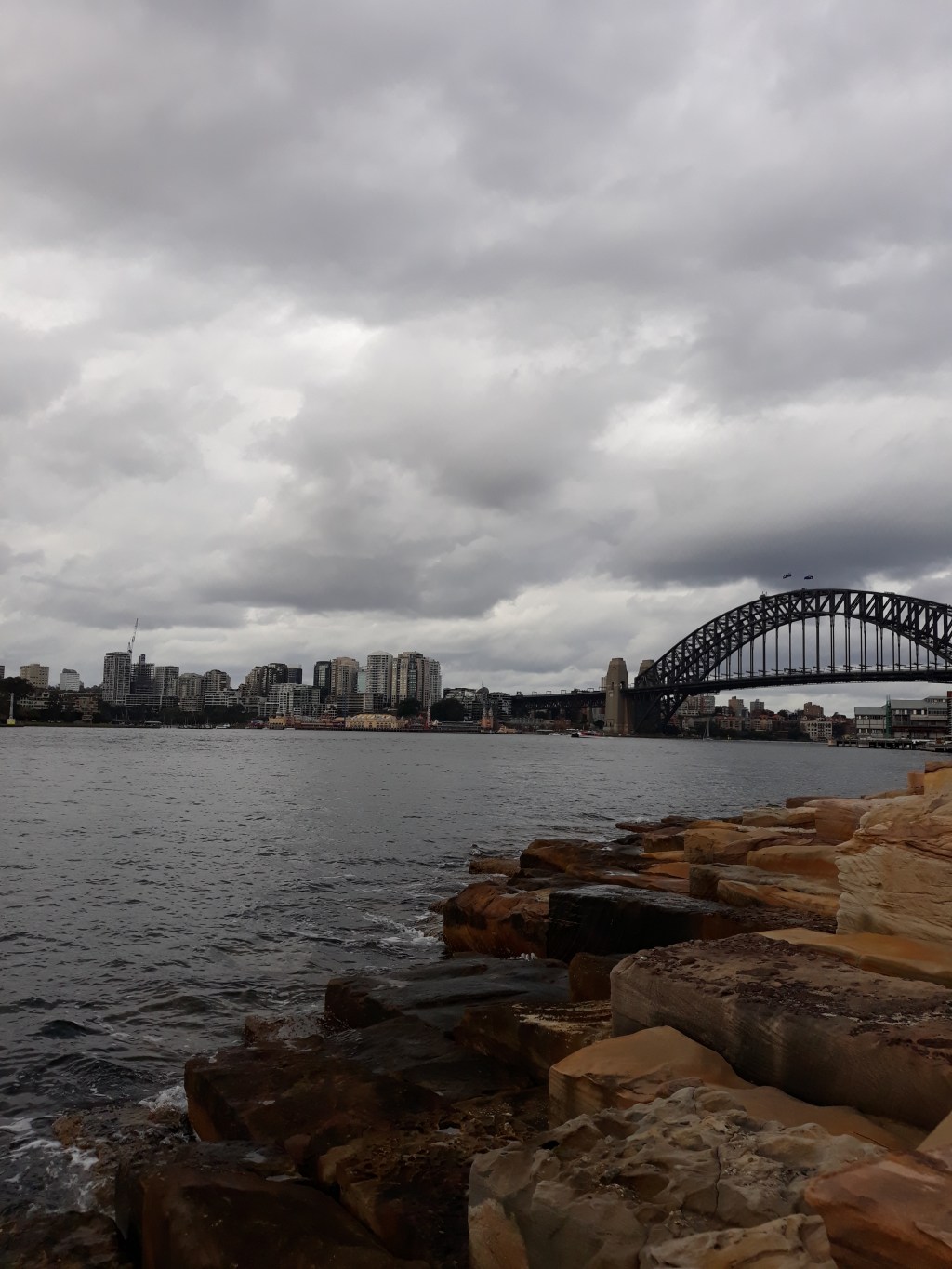
Sydney by definition starts on the coast and extends about 70km west (just before the Blue Mountains). Yes, it’s huge! Unlike many big European cities (I’m looking at you Paris), most of our “major” sites are located within the central business district making it compact and easy to just stay within the same postcode. Sadly, it means that when visiting Sydney, you are likely to only seeing a pin prick. Here, I hope to share a little more of Sydney with you in the hopes that you can pencil in one of the suburbs to see as well.
Whether it was what you had been exposed to in your home country, what lies other Australians have told you (there are no drop bears for the record) or what you had heard, here are 10 insights into Sydney (and some apply to Australia as a whole).
It is more multicultural than you have seen and think One of our greatest TV show exports (if you can even call it that) is a soap opera called Home and Away. You might have seen it, a beach town suburb filled with lifesavers, a caravan park and so much drama. And also has a cast that is very anglo-saxon. Statistics from the 2016 Australian Census have revealed that 49% of the Australian population were either born overseas or had one or both parents who was born overseas. That is nearly half the population. With such a long history of migration, walking around Sydney is like you’re at a United Nations conference. Any cuisine you can think of, I’m sure you’ll find a restaurant somewhere in Sydney serving it (see number 9!). Want to know more about a particular culture? There will be a festival celebrating one of the many cultural events somewhere in Sydney.
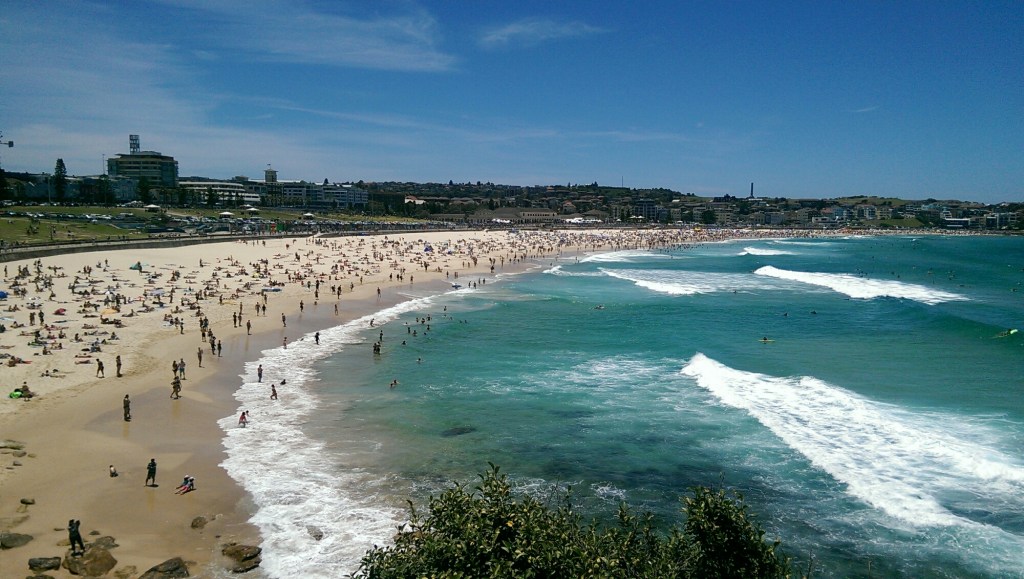
2. A lot of expats live in Bondi and Manly These beach cities are not only popular tourist attractions but are also home to many expats and backpackers. As a local, visiting one of these beaches is actually a logistical nightmare if you don’t live in the Eastern suburbs or around Manly. You have to cross some of the busiest roads and parts of Sydney to get here and there is also very little parking. Other beaches that are not Bondi or Manly include Coogee, Balmoral, Freshwater, Maroubra, Palm Beach and Curl Curl. It’s also much nicer to go to the beach or do the Bondi to Coogee walk on weekdays so make sure you plan that in if it’s on your list.
3. Sunscreen is a must any day of the year Australia has one of the highest skin cancer rates in the world which is helped by the hole in the ozone. Therefore, sunscreen is highly recommended (yes, even on cloudy days). Luckily, sunscreen is quite cheap here and sold everywhere in all supermarkets, convenience stores and pharmacies. There has been and still is a strong public health campaign every summer to remind everyone to slip, slop, slap. Slip on a shirt, slop on a sunscreen and slap on a hat. This message is taught to all Australians at a very young age and if you’ve ever met another Australian travelling, I’m very sure they are the ones putting on their sunscreen.
Martin Place in the morning on a weekday
4. Buses are hard to navigate even for locals Unless you know where you want to go and where the bus stops are, you have almost no hope. I’ve previously written about how to catch public transport in Sydney which may help but everyone’s advice will be to take the train/taxi/uber. Buses need to be researched before you get onto on and also where you want to get off. Our buses don’t have screens inside, route maps inside or announcements on what stops they will be stopping at so it’s only trial and error here. If you’re staying with the city area, the only bus you probably need to know about is the 333 to Bondi Beach (which can be caught from Circular Quay).
5. Sydney is not laid back (on weekdays) If you’ve ever been in town hall station in peak hour on a weekday, you will know not to stop walking anywhere. The wave of people will carry you and the same can be said of the traffic on the roads. The rush hour of business workers in the city makes peak hour walking and cafes/restaurants harder to navigate (so go before or after). Compared to the other capital cities here, Sydney-siders don’t have a reputation for being laidback.
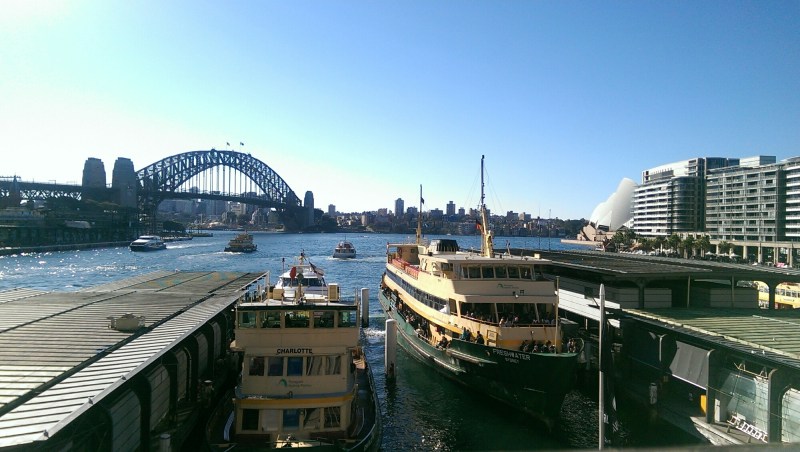
Circular Quay
6. Summers can be unpleasant and winters are freezing While it is true that the weather is generally quite nice all year round, there is always a few days each summer where the temperature is +40C. It’s become quite humid over the years too so it can be unbearable on these days with many staying inside. Unfortunately, summer nights are the same where the temperature doesn’t drop below early 20C and having sleepless nights because it’s so hot is quite a bonding experience for all. Winter, has its own challenges. As we have more warmer days, our houses are built to allow ventilation throughout and this is evident in winter when the temperature inside the house is almost the same as outside the house.
7. None of the locals drink Starbucks Australia has a huge coffee culture and there are many many MANY cafes in each suburb in every state. Born out of the strong migration of Italians, cafes are an establishment here. Every coffee drinker will have their favourite and it won’t be a Starbucks.
Not a Starbucks coffee
8. You won’t be seeing any kangaroos or koalasif you stay in Sydney Apart from at the zoo, you will need to head at least 2 hours out of Sydney (in any direction) if you want to see these famous animals. You will spot possums in Hyde Park if you’re walking around at night though. Speaking of kangaroos, kangaroos can be eaten here and its meat is actually very lean and a healthy option. You can buy it from supermarkets and should be eaten on the medium-rare side otherwise it becomes very chewy.
9. Suburbs are a treasure trove of food options If you want more and sometimes better food options, you can take the train to any of these options which will allow you to see a different side of Sydney that only the locals know and it will save you some money as well! Newtown is quite close to the city and offers quite modern food options. If you’re after south-east asian food, Cabramatta is where it’s at. For Lebanese food, try Lakemba, Middle Eastern food try Auburn, Indian food try Harris Park, Afghani food try Merrylands, Korean food try Strathfield and Chinese or Japanese food try Chatswood.
10. Tap water is free At any cafe, restaurant or bar, you can ask for tap water if it’s not already immediately being served to the table for free. It’s a requirement of the law and applies to the whole country. Sometimes it’s self served but it’s great to know so you don’t need to buy bottled water (which is expensive).
If you have already visited Sydney, let me know what quite didn’t live up to your expectations.
If you’re planning on Sydney, what are you expecting?
You can find Part I of the Peruvian Amazon Rainforest adventure here.
Day 2 We were up nice and early- breakfast at 5am so that we could leave our lodge at 5:30am. It was also my birthday today!
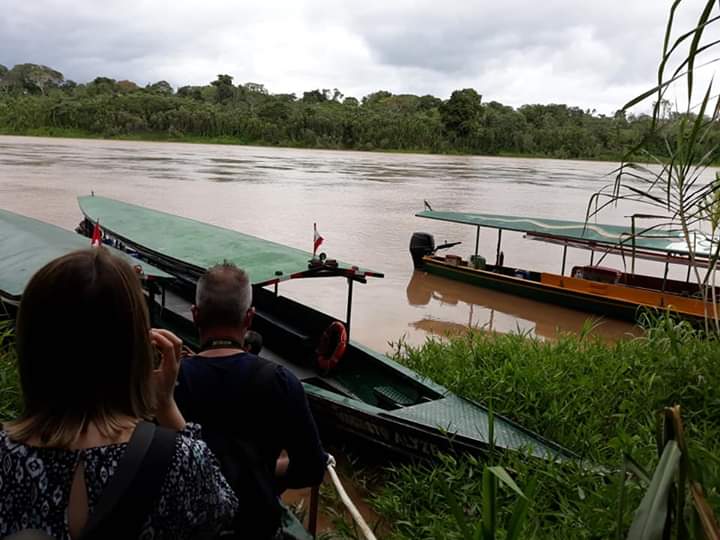
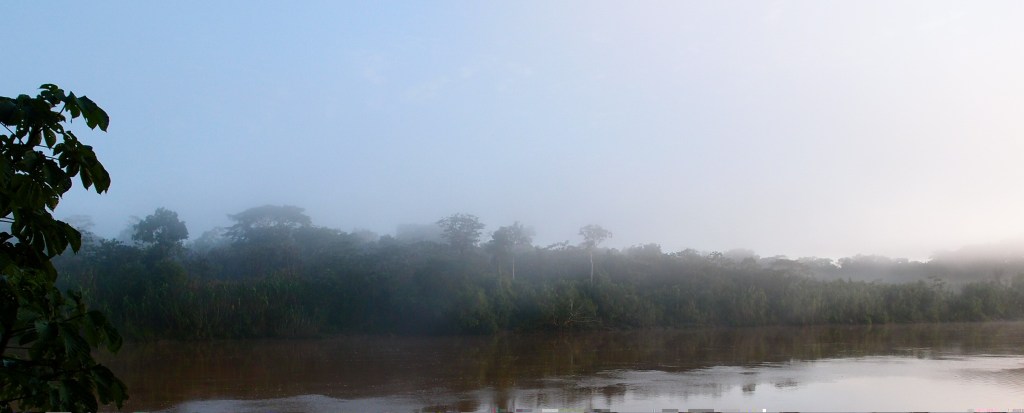
We headed onto the boat for a short ride through the misty and cool morning and got off for a 30 mins walk to a catamaran. This morning, we were going prehistoric bird, macaw and giant otter spotting. Lucky for us, we were able to see all of them this morning. The rainforest is definitely more alive in the morning. There was so much activity as the animals go to breakfast before moving on to avoid the heat of the day.
Morning mistOtter coming to investigate us
Our guides also fished a piranha for us to see- no-one was going to be sticking any body parts into the water anytime soon. It was so cool to see a live piranha. Their sharp teeth but really shiny exterior seemed like a double edged beauty sword. As we headed towards 10am, the sun was really turning up the heat! There was not a cloud in the sky and we were floating in the middle of the river with no shade. We were all sweating so much that butterflies started landing on some of us. We were told that a lot of the birds (and butterflies) supplement their diet by eating clay for the salt so I guess we were just salty deliciousness for them. Fortunately (or unfortunately), no anacondas were seen on the riverbanks during our morning out.
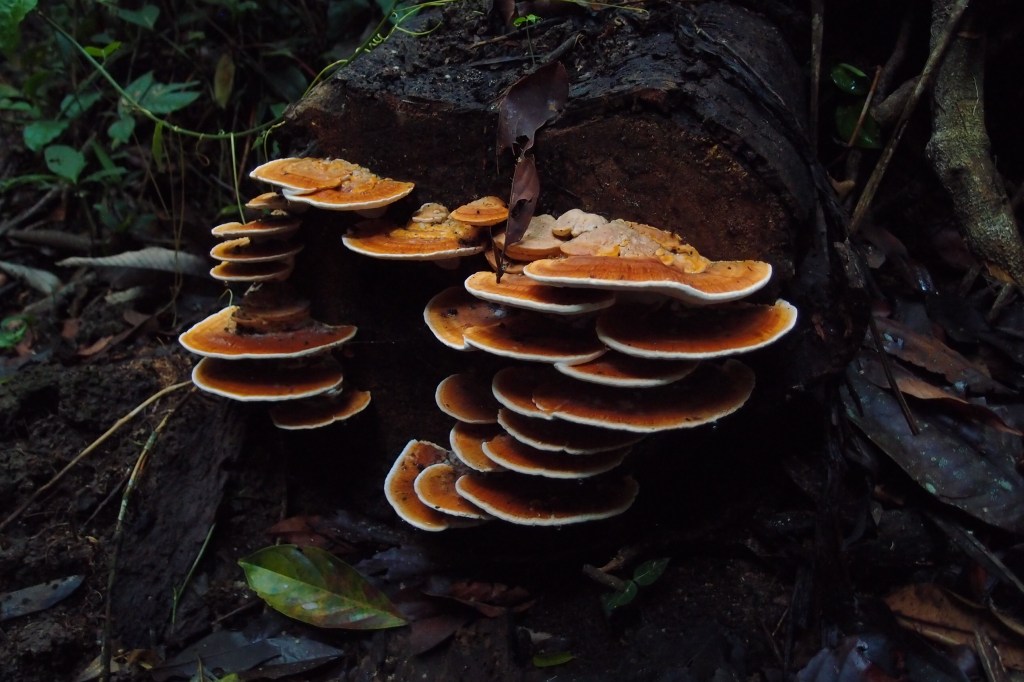
Mushrooms growing out of a log
We went back to the lodge for lunch and then hung out until mid afternoon. We were all so glad to be taking it easy at the hottest part of the day. During this time, I was sitting in my room when heard some commotion in the trees. With my camera ready (for whatever was out there), I was able to capture monkeys moving past my room in the trees! We headed out again for a food plant tour and tried some local beverages. Once night fell, we piled into our boats again to go caiman spotting. We did see some little ones and I was amazed at how our guides would see them from our boat in the middle of the river!
Back at the lodge for dinner, I was surprised with a birthday crown made out of leaves and cake! Not a birthday that I will be forgetting anytime soon.
Exhausted, we all headed to bed quite early as we were in for another early morning wake up call the next day. The weather had cooled down enough to doze off for another night to the sounds of the wild.
Day 3 Today was our last day in the Amazon. Another early morning exploration session, we set off at 5:30am after breakfast, this time to catch the morning feeding from the birds. The most magnificant coloured macaws, parrots and toucans were spotted this morning. The brighest and most beautiful colours and colour combinations flying through the sky and trees! I love the colours of nature.
We headed back at 9:30am to get our duffel bags and loaded up our boat to head back towards Puerto Maldonado where we collected our suitcases and repacked. We said a tearful goodbye to our guides at the airport- who were such a wealth of knowledge and welcomed us to their part of the world with open arms and warmth. Thank you Rafa and Darwin! Next stop:Cusco to Machu Picchu.
Have you been in the Amazon? Do you want to go? What did you love most about your experience?
Peru Tour: Intrepid Travel Amazon experience: Baawaja Expeditions
They say the easiest time in your life to learn a language is when you’re a child. Unfortunately for most of us, we don’t have a choice of what language we want to learn at that stage of our lives. However, we can learn a language at an older age and rest assured that whilst your brain isn’t as malleable as it once was, your brain is still capable of making new cells and new connections.
Languages for me have always been about opening my eyes to the world and connecting with people. It’s another medium to experience the world with and keeps the brain young.
I remember the moment in my life when I decided that I would learn Spanish one day. I was in Spain. Aside from hola, gracias y tostada con tomate por favor, I didn’t have any other words up my sleeve.
I had just arrived in Sevilla and showed my taxi driver the address of my Airbnb. He drove me into town to the Las Setas and told me this is as far as he can go and gave me directions (all in Spanish) and with hand gestures. I nodded and smiled with a thumbs up. I really should have done more research before I arrived and at least had pictures of a map on my phone. That was ill planning on my behalf. For those that have ever been to Sevilla, you will know that it’s a maze of winding streets. I ended up spending the next 60 mins asking random people for directions until finally, someone who has headed in the same direction took me in the right direction. I decided that before the next time I end up travelling to a Spanish speaking country- I would learn Spanish (formally).
Fast forward a few years later and I am sitting in my first Spanish class at the Cervantes Institute in Sydney with other individuals nervously chatting to each other like we’re all in kindergarten. There is something comforting about being in the same room with other adults ready to learn about something by choice. Everyone had such different reasons for being there. For some (like myself) it was for travel. Others had partners and families who were Spanish speakers and they wanted to be able to finally converse more in-depth with their in-laws. Some simply wanted to meet new people and challenge themselves.
For the next 8 weeks, we learnt through whiteboard notes, powerpoint presentations the teacher made to introduce us to Spanish/hispanic culture and geography and games. I love learning about the language idiosyncrasies that can explain why certain cultures think and value different things in certain ways. We played so many games. Hangman, listening to Spanish songs, snakes and ladders and class trivia. Time really does fly when you’re having fun.
I continued on with classes for over a year. Loving how much fun the classes were (most of them!). Whilst not fluent or anywhere near being able to understand the news, it has helped me since on my travels to Spanish speaking countries.
I think it comes down to having the motivation to learn. Perhaps it will take longer as an adult but if you’ve got a language or 3 under your belt, that really helps with learning a new language. Perhaps you’ve already picked up on words through family, friends, travels or through media. Whatever the reason and what ever the language, it’s never too late to start.
Have you recently started learning a new language? How has the journey been so far?
This post contains affiliate links where I will earn a small commission if you make a purchase through these links and will not cost you anything extra.
After a handful of days in Mexico City, our next town on the tour was to Queretaro. We travelled 2.5 hours north via coach from Terminal Centrale de Norte. I’ve been on a lot of buses in my life when travelling and let me tell you, this coach was the best bus I have ever been on! This was a fancy coach that included a drink plus small snack, tv screen and comfortable armchair seats. It was a double decker bus with a bathroom on the lower level. The movie selection was akin to something you would find on planes (but all in Spanish). I love going on drives when I’m the passenger so spent most of my time looking out the window.
Along the way, I saw the biggest flock of birds I have seen in my life. Hundreds of small black birds dotted in the sky.
Aquaduct
Pulling into Queretaro, I could immediately tell that this was a wealthy town. Rumor has it that all the gangs have their family homes here and it’s an agreed upon war-free zone. Not sure how true that is but let me know if you’ve heard similar. There was just alot of new houses and new business buildings and not to mention a new aerospace research facility.
When we arrived at the bus stop, the city immediately felt safer than Mexico City. There were also alot more families out and about. We loaded our belongings into taxis for our hotel in the centro historico. The centro historico was filled with colonial coloured buildings mostly earthy tones with flowers peeping from the rooftops. It’s small enough to have a wonder around and there were so many outdoor gardens and public spaces for gatherings and outdoor eating.
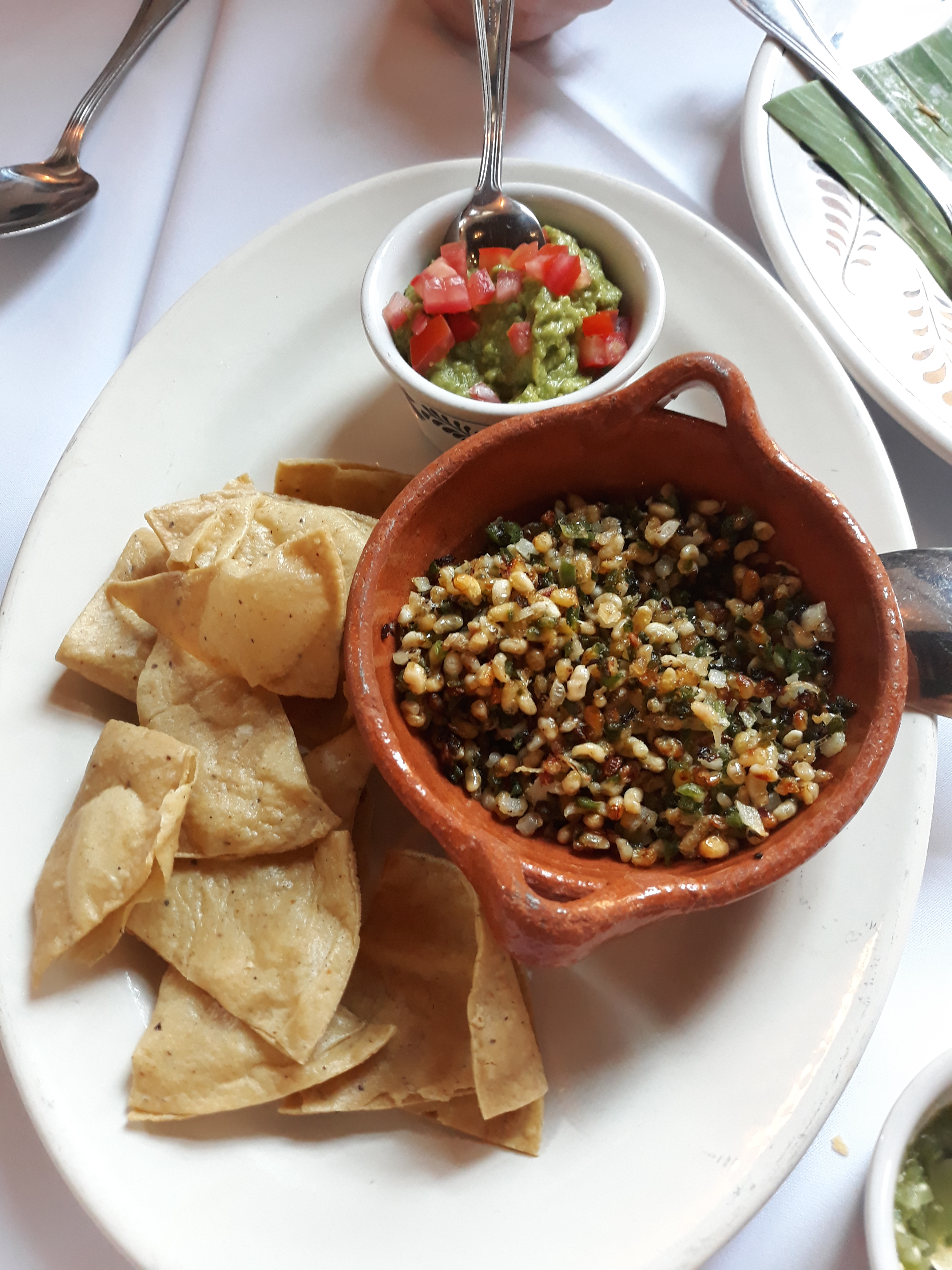
Our hotel was lovely! It had an inner courtyard and felt quite homey. After check in, we went to a nearby restaurant to have lunch as a group at Cervecería 25 & 50 Centro. This is where I tried escamoles (ant larvae) for the first time. The escamoles were actually quite nice and almost has the texture of pearl barley or brown rice. Anything with fried tortilla, avocado and salsa will be delicious! This was actually the only place throughout my time in Mexico that I saw escamoles on the menu so was happy to had taken the chance to try it.
Trying escamoles in Queretaro
After lunch, we went on an old fashion open bus tourist ride. Here we went to the Templo and Covent de la Santa Cruz which is famous for its orchid tress that have the shape of a cross and to the aquaducts which was started to be used in 1738! The aquaducts are still standing today (part of it) and are such a feat of engineering.
We also stopped at the Emperor Maximilian Memorial Chapel which is on the spot where he was executed. His remains are back in Austria but this was quite a popular tourist spot considering that it’s not so close to the centro historico. This is located within the grounds of the Univerisdad Autonoma de Queretaro and if you walk through the gardens behind the memorial chapel, there is a look out where the Monumento a Benito Juarez is.
Just to give you some historical context, Benito Juarez was the 26th President of Mexico and during his presidency, the french invasion occurred leading to Maximilian (younger brother to the Austrian emperor Franz Jospeph I) becoming Emperor. About 4 years later, the French armies withdrew leading to the fall of the Empire and capture of Maximilian. Benito Juarez had his power restored and is regarded as a symbol of Mexican independence from foreign powers. If you know about Cinco de Mayo, this is the celebration in Puebla of the Mexican army winning against the battle with the French army. You might be thinking to yourself that his name also sounds familiar, if you flew into Mexico City, the official name of the international airport is Aeropuerto Internacional Benito Juárez!
Walking around the centro historico
Back to my trip, we go back to town after our tourist bus ride around town and walked around the main streets. There were many stalls set up in the middle of town and and I gazed lovingly at all the handmade craft stalls. There was an expo on natural skincare products so we had a wonder in there as well.
As dusk began, we headed back towards our hotel and saw an outdoor dancing event in the square. There were many couples (most elderly) dancing the tango and I could’ve sat there all night watching. Many people were seated around the ‘dance floor’- it was warm and the city centre would only start to get busier as families came out for dinner. Prior to dinner, we ducked into the Church of Santa Rosa de Viterbo which was absolutely amazing inside. We only had a quick peep as it was about to close but the gold alterpiece was a sight to be seen. This is also where the large Queretaro letters are so and provided a great back drop for out last pictures of the day before the sun completely set.
We found a place nearby for some nibbles before crashing in bed later that night ready for our trip to Bernal the next day.
Have you been to Queretaro? What was your favourite thing there?
I can’t remember when it first appeared. This pull to go to Mexico, but I had put it off due to fear for about a year. Fear from what we see on the sensationalized news about Mexico. But in a small corner of my mind, I could see colours, music, a history I didn’t know much about and crafts. After hearing great feedback from people I know who had recently been to Mexico, I decided that I should just do it and booked onto a tour.
Some months later, I landed at the Mexico City International Airport. I didn’t know other countries in the Americas refer to themselves as being in America. I just think of the USA as America and every other country has its own name. So when I was asked at the airport where did I take the last flight from, America wasn’t a great answer. I felt like I had offended the whole country and didn’t even set foot outside the airport yet.
I usually don’t have expectations of the town or country that I’m travelling to. I know life is fluid and with time, cities do change. Here are my first impression’s of Mexico:
Food: As they always say, food in the country is better than imitations outside of the country. All I had really known prior to being in Mexico were tacos (the American way with sour cream and cheese) and nachos. Boy are we missing out! Succulent meat with more salsa toppings I have ever seen. Mexican cuisine is all about the textures and also having a combination of flavors of saltiness, sweetness, sourness and spiciness all in the one dish. I did find some dishes were too heavy for me (eg mole and tamales) or maybe it was just too hot and I just didn’t have the appetite (highly likely). I know each region has their specialty so only having been in a few regions, there is still many more to try!
My favourite dish that I had was the chiles en nogada which is a stuffed green chile with a creamy walnut sauce dotted with pomegranate seeds. Coloured like the mexican flag, this dish is popular in Central Mexico when pomegranate season begins. I also took a liking to chapulines (grasshoppers covered in lime and chilli) which not so coincidentally, goes so well with mezcal or tequila. Delicious!
Colour: One of the things that attracted me to wanting to go in the first place. I was not disappointed! I didn’t expect the towns to be so colourful until I googled the cities that I would be visiting. Unlike the Eiffel Tower or Strasbourg, I was just not exposed to travel pictures of Mexico. Which was a shame but now I have my own pictures to share. Streets lined with coloured buildings and even churches. I also loved seeing the alibrijes (folk art sculptures) in the souvenir stores, the colour combinations and detailing of some quite large and other minuscule animals. So much happiness to my eyeballs. The streets were simply accented with colour when possible- there were alot of murals, hanging flag banners and even saw pin wheels hanging outside a school. I think this perhaps is a celebration of the culture and is a popular medium of story telling within the country.
People: As a beginner Spanish speaker, I was secretly hoping that it would be enough to get by. It was ok and I found the locals really friendly and we tried our best communicating in my basic Spanish. Despite the language barrier, I felt really welcomed to each place whether it be a restaurant, site, museum etc which is not often the case. We also didn’t get pestered in the streets- once you say no, they move onto the next person and don’t follow you down the street like in some other countries. There was also this sense of proudness but not in the sense of arrogance. Proud of their history, food, culture and their willingness to show this overwhelmingly.
Safety: After reading what’s in the news, I was on edge from the moment I set food in the airport- not going to lie! However, I did eventually feel ok but in saying that, took extra precautions eg. only being out during the day/or with a big group of people and being aware of surroundings. I had heard of people being followed even in the day in busy areas so just be aware and reduce your risk as you would anywhere else in the world.
Cities: Each city was just so different from the next. I know this is often true in other countries but I feel that in Australia, all the big cities are quite similar. Mexico City is just like any other large city- busy, lots of people, traffic and things to do while the smaller cities were more quaint with each town’s history seeping into modern day life and quite varied architecture.
My first taste of Mexico did satisfy the ‘longing’ to visit and left me wanting more. I know that there are still a lot more contrasting areas of the country to what the central area is like and in particular I am keen to head south east from Mexico city to Yucatan.
What were your first impressions of Mexico? Is it on your list still waiting to be seen?
Learning a language is no easy feat. People start learning for multiple reasons- for fun, for work, family/partners or living arrangements. It requires memorising, pulling apart sentences and learning how to reconstruct them and putting aside your pride to speak with errors with a native speaker.
My French learning started in high school with compulsory foreign language classes. Once I knew that we had to pick a language, my mind went straight to the Eiffel Tower. For 12 year old me, I had the stereotypical images in my mind of sophisticated women with red lipstick carrying baguettes walking down a street with their dogs, surrounded by red flowers falling from balconies.
And so started my journey! You can read about my journeyin French here.
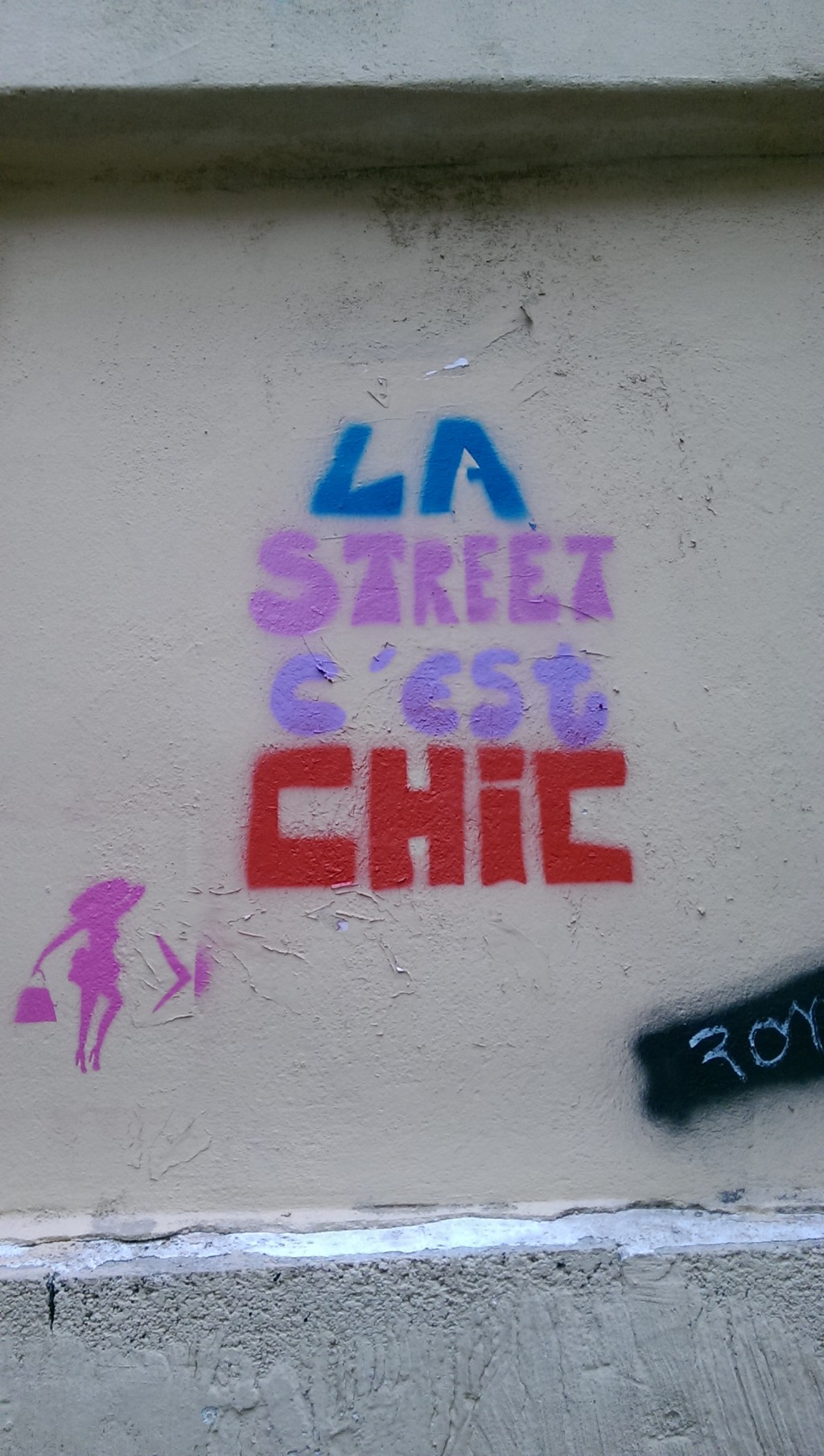
My first French teacher was an air of inspiration and would waltz into the room with a huge bonjourtout le monde. She had some much poise, was always wrapped in a colourful scarf and had on bright lipstick to match. She was the epitome of chic. She was also tri-lingual teaching Indonesian as well so compared to all the other teachers, she was the typical creative arts teacher.
Learning at school was a bit of a blur in the 4 years with 4 different teachers with varying teaching styles. I remember having to listen to scratchy french tapes, repeating verb conjugations as a class and dreaded speaking exams. When time came to selecting the subjects for the final 2 years of high school, I felt so behind on French that I wouldn’t have felt comfortable having to bet my high school score on it. So I made the choice to leave it aside.
I didn’t study French again until I was at university. I felt like I wanted to study it again and to learn something outside of my degree. I dabbled between classes at Alliance Française and at another local university. The teaching styles were quite different. Alliance Française was more structured with topics pre-set according to the curriculum and stricter adherence to the European Framework of References for Languages. The local university class was more fluid. We learnt different vocabulary across all topics within one class and the atmosphere was more relaxed although perhaps too unstructured for me. I also tried out conversation exchange during this time and found it ok but you really spend so much time trying to find someone who you will click with.
After my first degree, I started a doctorate degree which meant my time was consumed by science. I had to get to know a new research area so felt that there wasn’t quite enough brain space for a foreign language. I restarted French again once I started working full-time. It was the perfect way to feel like I was doing something for myself. Back to Alliance Française I went to complete classes until B2 level. By the last term of B1, I could really feel that I was lacking in some areas compared to my classmates and thought that if I kept going I would really struggle.
As such, I decided to take a break (which in hindsight was a bad decision!) and start learning Spanish instead! Learning Spanish was and still is on my radar so thought that my hiatus in French would be the time to dive head first into another foreign language. A year passed learning Spanish but at the back of my mind, I was still thinking about French. Given where I was last at in French class, I thought that the next logical step was to get a private tutor. I was thinking that I should probably get something out of all these years learning French so decided that I would sit the Diplome d’Etude en Langue Française (DELF) B1 exam.
This worked well as I now had something to aim towards. I was speaking a lot more and trouble shooting my grammar and writing. As I had an upcoming exam, I was on overdrive with my studying too. I was listening to French at every waking moment and found this method actually really effective at fine tuning my brain to pick up words and get the brain ‘thinking’ in French. I was also doing mock DELF exams with my tutor and reading more complicated articles across a wider range of topics.
The exam came around. I was so stressed! It would be the first exam I’d taken since being at university. I’ll go into more detail in another blog post but the day went by so quickly.
After my exam, I did some more private lessons but just felt aimless now that I didn’t have a goal to achieve. My tutor had accidently given me a practise DELF B2 exam and I could definitely tell that there was actually a really large gap between B1 and B2 level. B2 would obviously be my next aim but after noticing this huge gap, I really would need to dedicate so much more time to french. Undecided.
It’s been almost a year now that I’ve sat the DELF exam. I’m still listening to French as much as I can and sometimes reading news articles. I have the feeling that I need an all immersive environment to reach B2 but I could be wrong.
If you have any tips on working towards B2, please let me know! What made you start learning a language? How has your language learning journal gone? I’d love to know.
Our world here is slowly awakening from the social distancing measures that were put into place for COVID-19. Granted, Australia was lucky. Our Government had quickly closed our borders, carried out 14 days mandatory hotel isolation of guests arriving internationally and even closed domestic state borders. Offices were emptied as companies ordered their staff to work from home and the hospitality industry took a massive blow. Police were given the power to fine anyone outside or driving unless it was for one of the reasons listed under initial lockdown. Bars and clubs have been closed. Restaurants and cafes were takeaway only.
Over the past 2-3 weeks, restrictions have slowly been lifted although the 4 square metre rule (per person) seems to be staying. Restaurants and cafes are now allowing patrons with a maximum of 10 people capacity. I’ve noticed an increased in traffic and seen an increase in people dining out- people just keen to finally be able to catch up with friends and family again and to support our favourite local eateries. Even during lockdown, there was still such a strong demand for coffees and the weekly thai take-out.
There was a noticeable increase in the number of people out for walks, riding bikes and the local parks were the busiest I’ve ever seen during our lockdown. Finally! people had time to look after themselves and be with their families. Basic cooking supplies such as flour were stripped from the supermarket shelves as everyone went back to basics to create. Let’s also not forget about the toilet paper!
Since our supermarket shelves have started to be restocked now, I’ve noticed new brands being sold. Gyms and businesses had adapted to online classes and ordering. Companies have realised that their workforce were still working just as efficiently from home than in offices. It was like an awakening. I hope that we see a shift in town planning and how we live. Office spaces and large indoor gyms are not really needed anymore- could this pave the way for more urban green spaces?
I suspect everyone is still cautious about deconfinement.
Whilst wearing masks is not mandated in Australia, there are still a few people wearing them. Businesses have been adhering to Govenment regulations and I think people are glad to be doing their part and abiding by the rules that have been set for the general population. We were lucky here to still have been allowed outside to local parks and walks. Some state borders are still closed and there’s an emphasis on local tourism. I’m not really sure if this will kick off due to the large amount of unemployment that occurred and the general unease of the economic situation at present.
What are your thoughts on the deconfinement about to occur/occurring in your country? What are the general sentiments?
If you are looking up things to do in Mexico City, Teotihuacan will inevitably come up.
About a 1 hour bus ride north east of Mexico City and it is home to some grand pyramids that are dated to be about 2000 years old and is pre-Aztec. Little is still known about this site however, artefacts suggest that it was once a city that made some great obsidian goods from the nearby extinct volcano Cerro Gordo. This site in listed as a UNESCO World Heritage site and was named Teotihuacan by the Aztecs themselves.
We took an electric bus from nearby our hotel to main bus station (Terminal Centrale del Norte) where we joined the lines of tourists for the direct bus to Teotihuacan (duration 1 hour). Despite getting there before 9am, so did everyone else. The coach was really comfy and akin to the ones we have back home. I love having my face glued to the window on buses (un-interruped views) of colourful towns as we passed and then colourful murals as we got to the (modern) town of Teotihuacan. It is best to start early when going to Teotihuacan to not only beat the crowds but also beat the heat.
We had a local guide who accompanied us throughout the whole day. So much to tell us and so little time! The Pyramids are thought to be a gateway to the after life and so were a sacrificial site as well. The site sprawls out as far as you can see with the Avenue of the Dead 4km long which was thought to have been a bustling thoroughfare of market stores.
View from the Pyramid of the Moon
After we had seen the “museum” where original murals still exist within some of the structures, it was time to wonder around the Pyramids. First up was the Pyramdid of the Moon. When we went, this site was still open the public but I know this is topic is hotly debated (whether we should be allowed to climb it etc). We climbed it and it was tough because the steps, like all archeological sites, are quite steep. The views however, are the best as this Pyramid is on the west side so you have the whole Avenue of the Dead as far as the eye can see.
Pyramid of the Moon
Next, we lined up for the Pyramid of the Sun. This is the biggest Pyramid at Teotihuacan and is 65 metres high. There was a line to climb the Pyramid of the Sun and I think we were waiting for almost 30 mins. The first set of steps was tough but there is plenty of space for you to catch your breath. The rest of the rest of the steps up to the peak were easy because we were like a queue of ants, there was a lot of stopping and the climb was slower. By mid morning, the smog was becoming more evident.
There were so many people the entire climb- it is also one direction only so once you get to the top, the officials like to keep you moving along. On the way down, which was also bumper to bumper, we saw some sand tornados (is this what it’s called?) and butterflies. It just felt like spirits past had blown in with the wind and some sort of mysterious energy of the site.
It kind of gave me goosebumps thinking about how many other people had been to this site since it’s birth in 200 AD and how little we know about them and what they did. At the time of the greatest population, this town was said to have 100, 000 inhabitants!
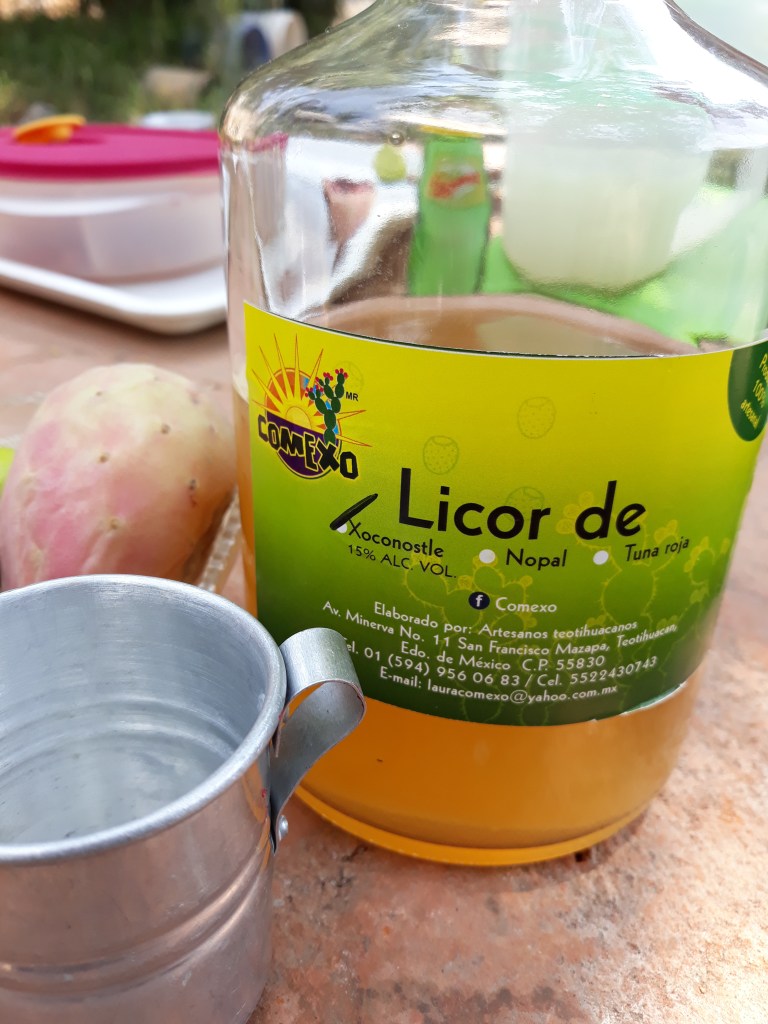
Our guide then offered some of us to take a quick trip to one of his friends place nearby so we went out of the archeological park and through some back streets. At the house (literally!) we were given some information about the agave plant and got to try some pulque which is a traditional central Mexican alcoholic drink made from fermented agave sap. We also tried tequila, mezcal and licor de xoconostle (prickly pear fruit). Each of us were so won over by the liquor that we all ended up getting a bottle each! We also got to see some handmade obsidian artwork.
When we went back to the archeological site, we met up with the rest of our group for lunch (they had already eaten and were just chatting) before heading back onto the bus back to Mexico City all exhausted and covered with sand.
I was a little disappointed that we weren’t able to freely roam the rest of the site. I think perhaps the rest of the structures further down the Avenue of the Dead are not as well preserved but I was really looking forward to also seeing the Temple of the Feathered Serpent (which was only discovered in 2003)! There are also other indoor museums further down that we did not get the chance to visit. I wonder how long it would take to see everything.
Walking with our guide to his friends place
Have you been to Teotihuacan? If so, did you like it? If not, is it on your list? And did you get to see all the sites on the otherside of the Avenue of the Dead?
Salut! Je m’appelle Sophie, le créateur de cette blog. J’habite a Sydney, Australie et ma langue maternelle c’est anglais (plus ou moins- une autre blog post peut-être). En Australie, parce que le distance de l’autre pays, apprendre la langue extranger ce n’est pas une importance dans la societe et a l’école. Je pense que c’est un gaspillage (je suis sur ce n’est pas correcte!)- c’est une grande monde et beaucoup de gens ne parle pas l’anglais. Evidemment, l’anglais n’est pas autant l’indicatif et c’est une chose que je trouve très difficile.
Finalement, j’ai décidée écrire une poste pour pratiquer mon français. Bien sur, le sujet que plus facile est a propos de moi et mon l’aventure de français. Mais, je suis hésitant parce qu’il y a un ans depuis je regularment pratiquer et “étude” le français. Je sais qu’il y a beaucoup des erreurs et les phrases dans cette poste! L’annee dernier, j’ai passe mon premier l’examen depuis l’univeriste! Le DELF examen B1!
J’ai commencé apprendre le Français il y a plusieurs l’annees- a l’école. Pour nous, c’était obligatoire a choisir une lange et donc j’ai choisi le Français parce que j’aime le son. Facile! C’est très sophistique et j’ai tombe amoureux de Paris (par des images). Je survivais quatre l’année et j’arrêtais parce que je perdais- beaucoup des vocabulaires et les réglés grammaires!
Apres, a l’université j’ai décidée a commencer encore. Je souvenais beaucoup des mots mais la grammaire, non!. J’ai étude un diplôme de science (psychologue) et après mon doctorate en neuroscience. Je suis allée la classe Française après la classe science! A la même temps, j’ai utilise ‘conversation exchange’ d’ici et j’ai recontre deux amis que je parle avec aujourd’hui. Quand, je faisait mon doctorate j’ai arrêté encore. Mon cerveau était plein! J’ai attendu une conférence en l’Europe pendent ce temps et je suis allée a Paris pour le premier fois! C’était mon rêve depuis j’étais petite! J’étais tellement très heureuse!
Pour le troisième fois, j’ai commencé apprendre le Français ENCORE quand j’ai commencé a travailler. Le même situation, après le travail je suis allée a la classe Française. Finalement, j’ai cherche une prof prive pour la preparation de DELF. Je suis très stresse avant et pendant l’examen. C’était très vite et j’avais beaucoup de l’adrénaline. Il y a un ans et maintenant je regarde et lire les journaux Français et regarde peppa pig en francais. Je trouve certains vloggers en Français que je regarde aussi.
Donc, c’est mon voyage a aujourd’hui. Je sais, c’est un voyage toute la vie et peut-être je serai courant une jour!














 Lingo in Transit
You must be logged in to post a comment.